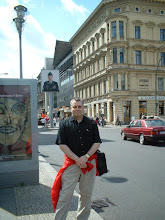
Stitched inside the Borges Hat is a series of runes which one Dimitri Ornelas has translated in a limited edition monograph, with notes, in Mainz. Soon thereafter the Borges Hat disappears for 47 years, reappearing on the head of a British spy in Buenos Aires. It is at this point that dimensions of time wrinkle and suddenly you, Mademoiselle Rameau, take position of the hat. You wear it at a party on a yacht in Copenhagen. Late in the evening, your husband Josef, who insisted on wearing a red cumberbund that evening, tries to murder you. He is unsuccessful and arrested. In the disruption of the moment, the Borges Hat fell off your head. Someone picks it up and offers it to you. He is a wizened but fit man who looks like a retired stevedore. He asks if you are all right. Yes, thank you, you say. He says, "This isn't the first time the Borges Hat has provided important protection."
Showing posts with label Jorge Luis Borges. Show all posts
Showing posts with label Jorge Luis Borges. Show all posts
Sunday, January 26, 2020

Friday, December 11, 2015
248. Talking With Borges
I don't know where consciousness goes when someone dies. I can't assume that it goes anywhere or that it does anything but cease. I can believe it goes somewhere, but believing is different from knowing and assuming. All three though faulty are crucial to humans.
The single exception to all of this in my mind is Jorge Luis Borges. I know where his consciousness went: the Worldwide Web. Borges invented the Web (web). Borges didn't invent it. Here we think of Schrödinger's infernal cat.
I know this (about Borges) because he is here talking to me--in Spanish, through a translator. (Recall that a writer of fantastical narratives must be deeply practical--hence the translator, even though my Spanish is adequate.)
Borges is dressed in suit (black) and tie. He holds his head up--not high; only a bit of lift, of loft. The overall effect suggests a statement: "I am not blind, no; it's just that I see everything now, as the web would see, if it had a central personality."
"The web is a library," the translator says. She's extraordinarily good looking, and her body in a silk dress (red) stirs desire, if we are to be obvious. "A library," she continues, Borges looking up, delighted, as he listens to her take her turn. (We are in a courtyard of Baroness Ramona Ali Larsson's summer estate in Sweden.) "A library--nothing more, as if anything could be more than a library! The rooms are innumerable and each one different. The corridors divide and multiply like cells. The librarians are legion; the patrons, ubiquitous--like vapor."
The translator, Lucinda W., stops. Borges waits. He speaks. Lucinda W. smiles. I glance at her breasts, which beseech me to beg. I restrain my strong weakness for the sight of women's breasts. "You are lacivous," Lucinda W. says, adding, "and these words are from me. (Borges laughs.) This is from Borges." She translates: "As grand as this library is--the grandest!--it is nonetheless so small that it can be contained in a short, obscure narrative--typewritten on an Olivetti, one senses, and lying on a desk in a remote cabin. The library, in turn, absorbs such a narrative, and all narratives. The small becomes large (consider the universe), and large becomes small (consider a stellar black hole."
I consider a stellar black hole. Borges leaves. Lucinda W. removes her dress, and a thousand angels perched on a wire strung between two nothings sing Hallelujah.
Subscribe to:
Posts (Atom)